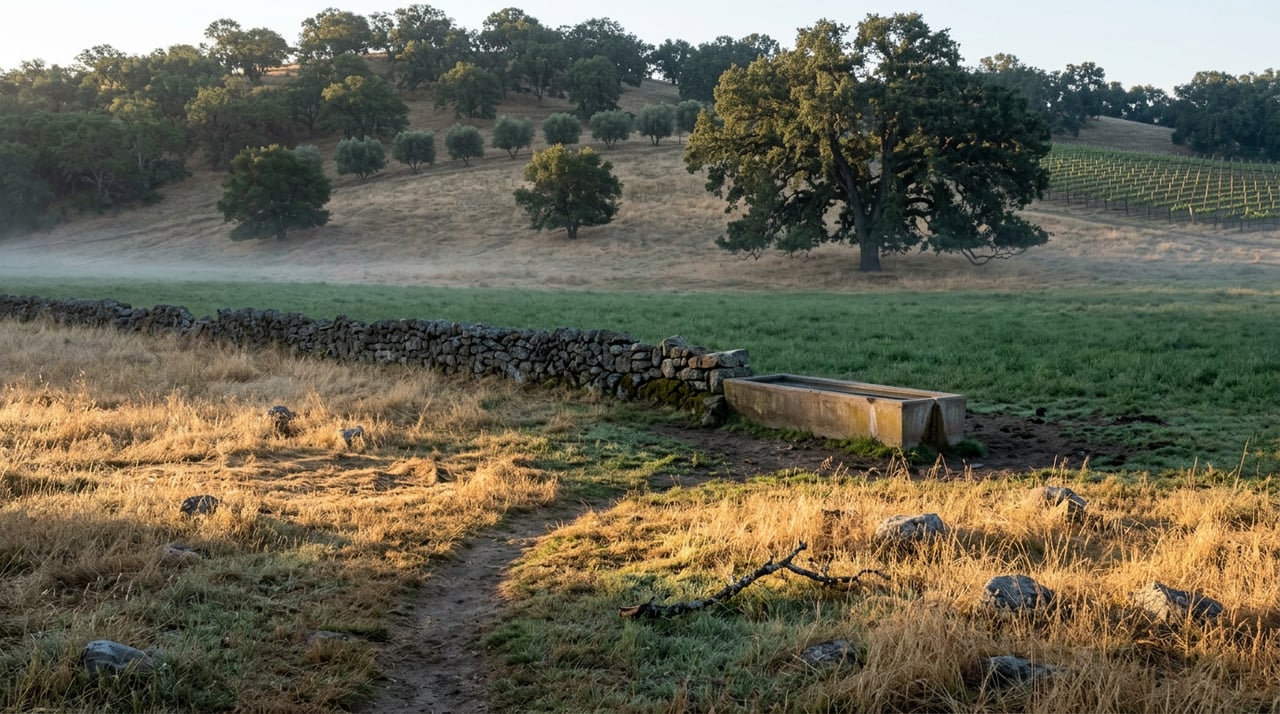
Picture two ranch parcels in the Santa Ynez Valley, both around the same size, both priced within a few dollars of each other per acre on the listing sheet. A buyer comparing them side by side would reasonably assume they're interchangeable. They are not. One sits in a groundwater management area with a different fee structure than the other, one has a well that was registered years ago and one doesn't, and depending on how each property's water use gets classified, the annual carrying cost between them could differ by three to five times. None of that shows up in the price-per-acre column. It shows up in a rate study, a permit file, and a conversation most buyers don't think to have until after they've already removed contingencies.
That gap between the number on the listing and the number on the water bill is the actual story in the Santa Ynez Valley right now, and it's worth understanding before you fall for a parcel based on acreage alone.
The Basin Has Three Owners, Not One
The Santa Ynez River Valley Groundwater Basin isn't managed as a single unit. Under California's Sustainable Groundwater Management Act, it's a medium-priority basin that was required to operate under a Groundwater Sustainability Plan by January 2022, and it's split into three separate management areas: Eastern, Central, and Western. The Santa Ynez River Water Conservation District participates in all three, but each area has its own governance and its own local rules.
The Eastern Management Area shows how recently this governance has taken shape. Its agencies, which include the water district, the City of Solvang, the county water agency, and the district's Improvement District No. 1, operated under a memorandum of agreement dating back to April 2017, then entered into a formal joint powers agreement effective July 16, 2024, just two years ago. That's recent enough that the rules governing an Eastern-area property could still be settling in ways that don't yet show up in a standard title search.
Why the Ag-Versus-Residential Line Changes Everything
Here's the mechanism that actually determines your carrying cost. Since 1979, the water district has calculated groundwater charge rates under California Water Code Section 75594, which sets a specific ratio: the rate for non-agricultural water use has to fall somewhere between three and five times the rate charged for agricultural use. A property irrigating pasture or vineyard rows pays one rate. A property using the same aquifer for a residence, a pool, or a guest house pays several times more per acre-foot.
That formula got legally complicated in 2022, when a California Court of Appeal ruled in City of Buenaventura v. United Water Conservation District that Section 75594's fixed ratio conflicted with Proposition 26, which requires that any charge structured like this be tied to the actual cost of providing the service rather than a statutory multiplier. The district still uses the 75594 framework as its starting point, but now has to justify it under Prop 26's cost-of-service standard, and it commissions an independent rate consultant every year to do exactly that. The district's 2026 Rate Study Report, dated May 12 and released for public review a few days later, sets out the rates that will apply for fiscal year 2026-2027, the fiscal year now underway. If you're buying a property where water use could plausibly be classified either way, that classification is worth confirming before you close, not after your first bill arrives.
Surface water matters here too, particularly for the agencies managing the eastern valley, where Improvement District No. 1 has historically delivered Cachuma project water alongside groundwater. The district has stated that it is not planning water rights releases downstream of Lake Cachuma during 2026, so a ranch that has leaned on those surface deliveries in past years is likely leaning more heavily on its well this year.
The Permit Verification Buyers Skip
If a property sits in the Central or Western Management Area, there's a specific paperwork step that rarely comes up in a listing conversation but should come up in a purchase negotiation: well permit verification. It requires four supporting documents and a $1,200 deposit paid to the relevant GSA before the district will confirm that a well's permit status is in order. That's not a fee a buyer wants to discover during the last week of escrow. Ask your agent to request this verification, or evidence that it was already completed, as part of your due diligence rather than assuming a functioning well means a permitted one.
| Management Area | Who runs it | What it means for a buyer |
|---|---|---|
| Eastern (EMA) | Water district, City of Solvang, county water agency, and Improvement District No. 1, under a joint powers agreement effective July 2024 | The governance structure is still relatively new; ask whether fees or rules have shifted recently |
| Central (CMA) | Water district | Well permit verification requires four documents and a $1,200 deposit before the district confirms permit status |
| Western (WMA) | Water district | Same four-document, $1,200 deposit verification process applies |
Carpinteria Already Lived Through This
If you want to see where groundwater compliance in this county is headed, look about forty minutes south. The Carpinteria Groundwater Sustainability Agency pushed its deadline for well owners to register their wells and install approved flowmeters to July 31, 2026, a date that has now come and gone. The next checkpoint is September 1, 2026, three weeks from now, when the agency connects those meters to its data system and starts billing on actual metered use rather than estimates. Wells that missed the window get assessed at the highest crop-factor rate the agency uses, the same rate charged to greenhouse and nursery operations, regardless of what's actually growing on the property. That agency, formed in 2020 by the Carpinteria Valley Water District, the City of Carpinteria, the county water agency, and Ventura County, exists for the same reason the Santa Ynez basin's management areas exist: state law now requires metered, accountable groundwater use, and the agencies enforcing it are moving from voluntary registration to hard deadlines with financial consequences for missing them.
Santa Ynez hasn't announced an identical metering mandate as of this writing, but the direction is unmistakable. A buyer evaluating a ranch today is buying into a regulatory trajectory, not just a static set of rules.
Why This Gets Skipped in a Moving Market
The valley's real estate market hasn't paused while any of this plays out. Through the spring and into summer 2026, new listings have kept arriving across Santa Ynez, Solvang, Los Olivos, Ballard, and Buellton at a pace that keeps buyers competing rather than deliberating, especially for well-presented ranch and estate properties. That pace is part of the problem. When buyers are racing to write a clean offer, water classification questions are the first thing to get skipped, and they're exactly the kind of question that's cheap to ask before contingencies come off and expensive to raise after.
Four Questions Worth Asking Before You Remove Contingencies
- Which management area, Eastern, Central, or Western, does this parcel fall in, and has that area's fee structure changed in the last two years?
- Is the well registered and permit-verified, and can the seller produce documentation rather than a verbal assurance?
- Is the property's water use classified agricultural or non-agricultural, and does that match how you actually intend to use it?
- Has the property historically relied on surface water releases, and if so, what happens to that supply in a year like 2026 when releases aren't planned?
Frequently Asked Questions
Does the agricultural-versus-residential classification depend on zoning or on actual use? The rate differential under Section 75594 is tied to the type of water use, not simply the parcel's zoning designation. A property zoned for agriculture that's used primarily for a residence can be classified differently than its zoning might suggest, which is exactly why this needs to be confirmed rather than assumed.
If I buy a property with an unregistered well, am I responsible for fixing that? Once you own the property, you own the compliance obligation. This is a strong reason to request well permit verification during escrow rather than treating it as a post-closing errand.
Is the Santa Ynez River Water Conservation District the same agency that supplies tap water to towns like Solvang? The district participates in groundwater management across the basin and includes the City of Solvang among the agencies managing the Eastern area, but municipal water service and basin-wide groundwater sustainability planning are related, overlapping functions rather than identical ones. Confirming which agency actually bills you for water on a specific parcel is worth doing directly.
Buying land in this valley has always meant buying into water, geography, and long-term stewardship, not just square footage. That's the lens Monica Lenches brings to ranch and estate transactions across Santa Ynez, matching each client with the water attorneys, hydrogeologists, and sustainability advisors who can answer these questions with certainty before you're financially committed to the answer. If you're comparing properties in this valley and want a clearer read on what a given parcel actually costs to hold, Live Your Vision. Start the Conversation.